De Stichting voor Doopsgezinde Geloofsopbouw en Solidariteit steunt jaarlijks een student Peace Trauma and Religion. Op onze website staat het vermeld, maar niet prominent. Hoog tijd dus om aandacht te besteden aan deze activiteit.
Het is de afgelopen jaren aan onze kant gebleven bij financieel ondersteunen. Het zou mooi zijn wanneer we als Doopgezinde organisatie (en dat geldt ook voor Doopsgezinde gemeenten) meer contact zouden hebben met deze studenten. Maar ‘Tussen droom en daad staan wetten in de weg, en praktische bezwaren’ zoals Willem Elsschot schreef. En dat is jammer want we kunnen veel van deze studenten leren.
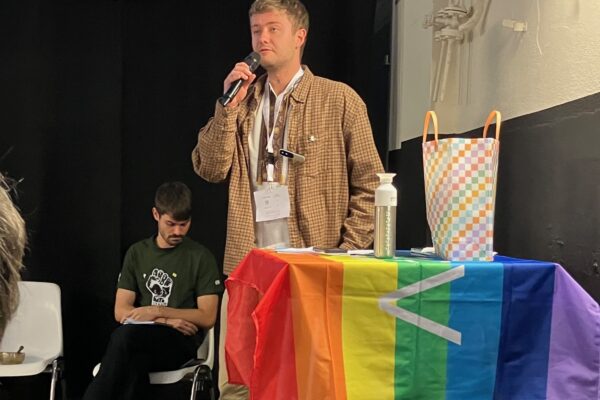
We vroegen aan Mikhael Ardiyanto, die nu Peace Trauma and Religion studeert iets te schrijven over zijn keuze voor deze studie, zijn ervaringen, wat hij wil gaan doen met het geleerde als hij terug is in Indonesië en wat wij van hem kunnen leren.
Dit was zijn reactie, zijn oproep aan ons. (liever in het Nederlands lezen? Klik dan hier)
‘Behind the busy rhythm of church life, I often wondered: what kind of peace are we actually building?
Back then at home, our family life rarely followed our own rhythm, it was more arranged by the church calendar. There were fellowships for children, youth, fathers, mothers with their own schedules. Then came choir rehearsals, meetings, and events tied to the liturgical season. Some days it felt like home was only a place to sleep, while our real life happened in the church building.
Some evenings were almost funny if I think about it now: choir rehearsal wasn’t finished, yet the meeting already started. Then the meeting turned into a long discussion that jumped from snacks to the theology of God’s kingdom. I would go home late, sleep, wake up. And, the next day it all repeats itself.
I also remember it very well. Every year on August 17th, Indonesia celebrates Independence Day. When I was younger, my neighbors in my neighborhood would organize a dinner and simple activities. But as I got older, that moment changed. The celebration was no longer on the small village road, but I was often busy with worship services at the church. While the people around my house were chatting and enjoying the moment together, I sat on a church bench attending the “independence service.”
There, I slowly began to ask myself, “If church means ‘called out,’ why do I feel more and more drawn in and separated from the world? If church is about ‘called out’, why do I feel further and further away from the people around me?”
Those questions eventually led me to study at the Jakarta Theological Seminary. Those moments made me realize that theology does not stop at the altar. Instead, it lives on the streets, in the voices of mothers and activists who stand in front of the presidential palace every Thursday, demanding justice for their children who were killed during the 1998 political unrest in Indonesia. It stands along with the resilience of everyday people and the social realities.
After graduation, I thought about becoming a full-time minister. But the reality was more complicated: a tight schedule, high expectations, and almost no room or ask why I was doing what I was doing. Thanks to the Bridging Gaps program, I finally had time to think. There, I was introduced to the PTR Master’s program and at the same time and it opened space for me to revisit the way I understood the church, society, and my own place in it.
Conversations with friends, lecturers, and cross-cultural life experiences made me realize that the social reality around me – and around the church – is far more complex than we often imagine. There are realities that rarely appear in church conversations: social justice, historical trauma, identity-based violence, and politics. shape how people navigate life – economically, socially, and even ecologically.
So, the question is, again, where is theology and faith? Is it only in the classroom, in academic discussions, or behind Sunday liturgy? Or should theology also be in uncomfortable spaces, where people wrestle with injustice, and even the wounded earth we all depend on?
Sometimes I hear people say, “Theology is fun.” And maybe that’s true. But the question is: fun for whom? For those who can read the scriptures calmly in a comfortable room? Or is theology also “fun” for those who have been hurt by it? For those who have been silenced, corrected, or excluded with Bible verses? For those whose wounds were not caused by the absence of religion, but by the way religion was used?
Learning here challenges me not only to look at myself, but to realize theology cannot function only as an answer- to allow theology to be questioned. To let it learn from different stories, different lives, different realities. It needs courage to change.
And there I learned that theology is not only about speaking. It is also about silence and listening – listening to the land, and to the people who live on it whose stories are not always heard. However, the funny thing is, the more I learn, the more living in the Netherlands makes everything feel more complicated: How do I speak about justice, peace, and theology in a place whose history is also connected to injustice in my own country? Often, conversations about peace and justice begin with the idea that everyone here is progressive and tolerant. And in many ways, that is true. But sometimes, that narrative leaves little room to talk about the colonial past that shaped both our histories.
So, when I imagine life after finishing this program, I don’t imagine it as an ending. I see it as a conversation that will keep moving, shifting, and growing with new experiences. And yet, that’s where the process begins. It is never concluded in a single study program, one thesis, or one church initiative. It needs ongoing relationships, shared reflection, dialogue, and the courage to question what we have taken for granted.
So, the question is not merely “what I will do after graduation,” but how can we, people here and there, keep learning and collaborating together? What must we hear, learn, unlearn and eventually do together, as a church that is called out into the world?’